
 0086-20-3156-0779


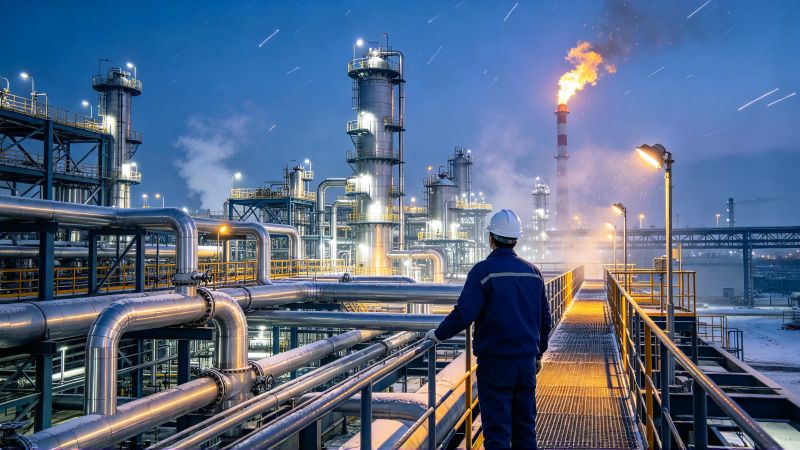
On 27 October the National Bureau of Statistics reported industrial profits for January to September 2026: RMB 6.03 trillion in total, up 15.5% year on year, with an operating margin of 5.68%, up 0.44 percentage points from a year earlier. Manufacturing profits rose 17.0%, mining 38.2%, and electricity, heat, gas and water supply fell 14.3%.
Within the sector table, chemical raw materials and chemical products manufacturing grew 49.2%, behind computer and electronic equipment at 103.8% and nonferrous smelting at 79.7%. Automotive manufacturing fell 22.8% and ferrous smelting 73.3%, so a single headline conceals a wide dispersion.
Yu Weining, chief statistician at the bureau's industrial division, attributed the chemical figure to higher international crude prices, which also returned petroleum processing to profit at RMB 84.22 billion. A large part of the 49.2% is price, not volume or product mix, and reading it as a broad new-materials boom would be a mistake. The structural signal sits elsewhere: raw materials manufacturing profits rose 44.9% and contributed 5.9 percentage points to the national total, and within that category crude-linked base chemicals and import-substitution materials are moving in different directions.
POE belongs to the second group. Its margin does not track crude; it tracks the spread between imported and domestic resin, and who gets a grade qualified into a customer's certification system first. There is also a lag between a profit line and a headcount line of 18 to 36 months. Henderson Executive Search works with clients on the far side of that lag, where the capital has already been spent and the people have not yet been found.
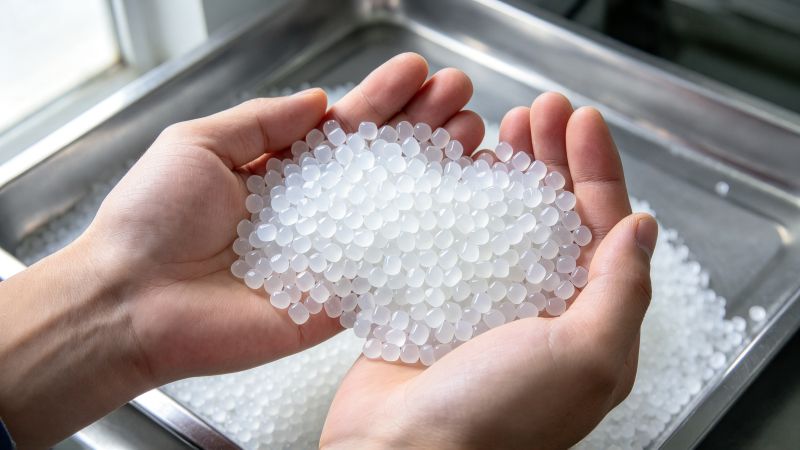
On 23 September the 30,000-tonne-a-year solution-process POE demonstration unit at Daqing Petrochemical achieved full flow and produced pellet on first start-up, the first industrial application of PetroChina's independently developed solution POE process. On 12 October the first 31.5 tonnes of octene copolymer left for photovoltaic encapsulant film and automotive compounding customers in East China. Nineteen days separates the two events. By 14 October the unit held 100% load at more than 60 tonnes a day, and by 21 October cumulative qualified output was close to 700 tonnes, on ethylene feed of 2.75 tonnes an hour and octene at 3.66, both made on site.
The staffing detail matters more than the tonnage. A start-up task force was formed, five youth shift crews assembled, classroom training and simulator drills run in parallel. Facing what the company described as no mature operating experience to draw on, the technical team watched product index and density, recalibrated parameters, adjusted additive injection and worked through unstable reactor feed and pressure swings. Not one sentence concerns how many people were recruited; all of it concerns how people were trained.
That is the real position of a first-of-its-kind domestic plant: the difficulty is not hiring, it is that there is nowhere to hire from. Solution POE experience has sat with Dow, ExxonMobil and Mitsui Chemicals for decades, and no domestic line of the same process had been running, so the pool with three years on a comparable unit amounts to a handful of plants. The only route was to transfer people from adjacent processes, use simulation to fill in flowsheet knowledge and let shift crews grind parameters. That works on a 30,000-tonne demonstration unit. On a commercial line one unplanned shutdown costs millions.
Three figures locate the industry. According to Sinopec News in September, domestic POE capacity reached 860,000 tonnes a year by August 2026, up 27% from the end of 2025, with the increase coming mainly from Daqing's 30,000 tonnes, Beiyouyi's 100,000-tonne second line and the first Sinopec Tianjin train. Industry planning figures put capacity under construction and proposed at more than 6 million tonnes a year. Demand is estimated at about 1.4 million tonnes in 2026 and possibly 1.8 million in 2027.
Prices already reflect the arithmetic. From the second quarter of 2026 the domestic market ended a long period of scarcity premium, with mainstream grades falling RMB 2,000 to 4,000 per tonne from their annual high and some commodity grades down more than 20%. Imports are collapsing in parallel: customs data show 284,300 tonnes in January to July, down 37.82% year on year, with another cut of the same data putting the January to August decline at 38.65% and exports up about 120%.
Overcapacity and talent shortage can hold at the same time, and here they do. Capacity is a problem money solves; commissioning experience is not. Equipment can be ordered, catalysts developed in-house or licensed, processes bought. A person who knows at which operating window the reactor will foul, or at what vacuum the devolatilizer will carry over, can only be produced by going through start-ups. Delivering 6 million tonnes of planned capacity requires several hundred people who can make that judgement, and that is the constraint Henderson Executive Search is asked to solve.
That is why the demand curve in chemical recruitment is not smooth. A plant project draws on three phases that barely overlap. Construction needs process design, equipment, piping and instrumentation. Commissioning needs a start-up crew, DCS panel operators, laboratory analysts and equipment specialists. Steady state needs process technology management, grade development and customer qualification. The phases sit months apart, and candidates for each need years on another unit. Projects commissioning between 2026 and 2027 are now caught between the second and third phases, which is where most POE briefs reaching Henderson Executive Search originate: the milestone is fixed, the people are not.
| Company | Unit and milestone | Process route | Roles it pulls |
| Daqing Petrochemical | 30 kt/yr demonstration unit started 23 September; first 31.5 t shipped 12 October; near 700 t by 21 October | Solution (proprietary package) | Start-up crew, DCS operators, process technology, laboratory |
| Sinopec Tianjin | 100 kt/yr trialled in March; first qualified product 14 August; 99% domestic equipment | Solution (fully localized) | Polymerization process engineers, equipment and instrumentation, quality and grade development |
| Beiyouyi | 100 kt/yr second-generation unit at stable full sales in July; utilization above 100%; 100% qualified | Solution (high-temperature) | Process optimization, grade development, customer qualification, devolatilization |
| Dushanzi Petrochemical | 60 kt/yr gas-phase; close to 60 kt produced in 2025; energy use about 60% of solution process | Gas phase | Fluidized-bed process, gas-phase operations, energy performance |
| Wanhua Chemical | 200 kt phase one producing since June 2024; 400 kt Penglai phase two under construction with 150 kt alpha-olefin | Solution | Process package development, alpha-olefin unit, catalyst R&D |
| Shaanxi Yuneng | 100 kt/yr EPC signed 23 September; 480-day schedule; cost about 20% below the ethylene route | Coal-based H-POE | Coal-chemical process engineers, methanol-to-olefins, project construction management |
Source note: milestones from PetroChina, Sinopec News, CNR and Xinhua Heilongjiang reports (September to October 2026), plus company announcements and public conference material. The role column is compiled from public job postings and unit phase, not from company statements.
China now runs three industrial POE routes, a position no other country holds. Solution polymerization is the international mainstream and the path of most domestic units. Gas phase exists at Dushanzi alone, solvent-free at roughly 60% of solution energy use. The coal-based H-POE route is newest, taking coal-derived methanol as feedstock and cutting cost about 20% below the conventional ethylene route. The three differ in capital intensity, energy use and grade coverage, and companies choose on feedstock availability.
The requirements are not transferable. Solution POE is decided after polymerization, in devolatilization and pelletizing: the solution is viscous, the solvent must be recovered, residual monomer controlled to the ppm level. Gas phase is another discipline, built around fluidized-bed kinetics, the match between bed height and circulating gas velocity, and control of static and sheeting, none of which accumulates on a solution line. The coal route adds methanol-to-olefins feedstock variation and coal-chemical utilities. An engineer with ten years on solution process moving to gas phase starts as an apprentice again.
That immobility amplifies the shortage. If routes were interchangeable, 860,000 tonnes of operating capacity would draw on one pool. They are not, so there are three small pools, each counted in double digits. Employers face three options: pay up within the same route, develop from adjacent processes, or hand commissioning to an experienced engineering contractor. The candidate maps Henderson Executive Search builds in polyolefins start from the short list of lines that have actually run.
In 2022, import dependence for photovoltaic-grade POE resin exceeded 95%, and global capacity sat with Dow, ExxonMobil and Mitsui Chemicals. Four years later, according to the China Petroleum and Chemical Industry Federation's 2026 white paper on the polyolefin elastomer industry, global capacity stands at 2.6 million tonnes a year, China accounts for more than 70% of additions, domestic capacity is 650,000 tonnes, and the country's share has risen from under 5% in 2020 to 25%. With Sinopec's Tianjin and Zhenhai units running 250,000 tonnes, import dependence falls to about 53%.
That decline needs to be read in layers. New domestic capacity is weighted toward C4 grades, ethylene copolymerized with 1-butene, where substitution is fastest and price competition sharpest. C8 grades, ethylene with 1-octene, demand more of the catalyst, the process and batch consistency; domestic volume is limited and some core supply still comes from Dow and ExxonMobil. Wanhua and Eastern Shenghong have both entered C8, but volume is early.
Downstream qualification has moved faster than capacity. Photovoltaic encapsulant film remains the largest outlet at 45% of 2025 consumption, localization of high-end POE film for N-type cells has passed 85%, and in the first quarter of 2026 Chinese film makers sourced more than 75% of their POE domestically. The 31.5 tonnes that left Daqing were destined for those two qualified outlets.
For the polyolefin elastomer talent market, the C4 and C8 split matters more than the domestic and imported split. C4 engineers can come from the country's large base of polyethylene units, so supply is comparatively loose. C8 engineers need hands-on octene copolymer experience, and the number of lines that can provide it is small, one being the 1-hexene and 1-octene unit Daqing started in July. Structural gaps in chemical new materials talent grow where only a few lines exist.
Four postings published in October price four different capabilities under similar titles. The first is on-site process work: a polymerization process engineer for a pilot unit at a Nanjing clean energy company, RMB 12,000 to 18,000 a month, five years or more in polyethylene or polypropylene, writing start-up procedures and watching the DCS. The second is a seasoned engineer at Puxijing in Shanghai, RMB 20,000 to 30,000 across 14 months, familiar with reactor, column and extruder selection. The third sits in the same band with a higher bar: a senior process engineer at Kingfa in Ningbo, master degree, eight years, requiring solution polymerization and devolatilization experience and prior package design on EPDM, POE or SEBS.
The fourth jumps an order of magnitude: a chemical process engineer in Tianjin at RMB 65,000 to 85,000 a month, five to ten years, master's degree, responsible for polyolefin plant design from feasibility through process package development, running Aspen Plus simulations and facing the licensor. That is the price of building a line from nothing, three to five times the third band. Henderson Executive Search sees the same gap at the offer stage, where budgets for the fourth band are approved against the third band's grade table.
| Level | Published range | Experience and education | What the person can do |
| Process engineer, pilot unit | RMB 12-18k per month | College diploma or above; 5+ years polymerization; 2+ years technical management | Start-up procedures, DCS diagnosis, fault handling |
| Polymerization process engineer | RMB 20-30k per month, 14 months | Bachelor's or above; 6+ years including 3 on polyolefin units | Reactor and extruder selection, shutdown and start-up, optimization |
| Senior chemical process engineer | RMB 20-30k per month | Master's; 8+ years; process package development | Pilot scale-up, solution polymerization and devolatilization, grade development |
| Process engineer, design side | RMB 65-85k per month | Master's; 5-10 years polyolefin plant design | Process package, flow simulation, licensor interface |
Source note: published ranges as of October 2026 from Liepin, Chenhr and Jinri Rencai. The same title varies widely between employers and actual offers often land below the top of the band. The four levels are not a grade sequence within one company; they illustrate capability tiers.
The industry agrees on the three constraints in POE: metallocene catalysts, alpha-olefin feedstock and continuous polymerization. The catalyst is the deepest, because it sets molecular weight distribution, comonomer incorporation and batch consistency, which is close to the genetic code of the product. Feedstock is the second, since supply of higher alpha-olefins such as 1-octene has long rested with a small group of foreign producers and remains one reason domestic POE cost stays high.
Both saw real progress in 2026. In July, Daqing's 50,000-tonne 1-hexene and 1-octene unit completed full flow on first attempt, filling a domestic gap in higher alpha-olefins and making the September POE start-up possible on self-produced feedstock. On catalysts, Dingjide developed its POE catalyst in-house at a cost 65% below purchased equivalents, brought a 200,000-tonne first phase into production and reported first-half net profit growth of 848% to 1322%. Wanhua spent a decade building its own metallocene system and has the tightest quality control domestically.
The people in these two areas differ from plant-side staff. Plant work runs on operating experience; catalyst work needs research and industrialization at once, generating activity data on a bench and solving catalyst injection, deactivation and residue handling on a commercial unit. The number of people in China with both halves of that experience is counted in the hundreds, concentrated in a few petrochemical research institutes and leading companies, and they rarely appear on job boards. Compensation often sits outside the standard scale. Henderson Executive Search usually finds the core candidates in catalysts and alpha-olefins have already spoken to several companies before a search formally opens.
The first is time. A 100,000-tonne POE unit takes 24 to 36 months from engineering to mechanical completion; the Shaanxi Yuneng EPC contract specifies 480 days, but that covers construction only. A start-up team needs 12 months of preparation for training, simulation and internships, so a line due to start in 2027 should have its people fixed in the fourth quarter of 2026.
The second is the cost of trial and error. An unplanned shutdown on a solution line brings material loss, cleaning, restart and off-spec product, running from hundreds of thousands to several million renminbi. Grade development is more invisible: six to twelve months from bench formulation to downstream qualification, with any batch variation restarting the clock. Henderson Executive Search sees the same disagreement in plant briefs, where the hiring manager wants someone who has started a unit and human resources benchmarks the grade, and the gap surfaces during the start-up weeks.
The third is retention, the one most often missed. Starting a unit, holding steady state and developing grades are three capabilities, and many employers only need the first. Once the project closes and the unit stabilizes, a crew with no next project begins to leave. Henderson Executive Search sees clients increasingly run commissioning teams as a standing function reused across projects, which retains better than a one-off bonus because it offers continuity.
The profit figure needs care. The 49.2% growth is an above-scale industrial enterprise measure that includes the effect of higher crude prices, and it does not represent the profitability of chemical new materials. The price signal specific to POE runs the other way, with mainstream grades down RMB 2,000 to 4,000 a tonne since the second quarter. The two facts describe divergence within the sector, not a sector-wide boom.
Capacity figures differ by definition. The federation white paper gives 650,000 tonnes for 2026 on a nominal annual basis; Sinopec News reported 860,000 tonnes cumulative as of August, including units newly started and in trial production. Both are cited side by side and neither converted. Pay data are published ranges, an employer's recruitment budget rather than a settled price, and the four levels come from different companies, cities and grade structures.
One final limit: no authoritative estimate of the total POE talent gap exists. Association white papers cover capacity and consumption, not vacancies, and mid-to-senior process roles largely do not pass through public channels. This article therefore offers no total, only verifiable structural facts: unit milestones, capacity against demand, trade flows, published pay tiers and the non-transferability of process routes.
Where do companies find POE polymerization process engineers in China?
Four routes. Peer POE units already running domestically, the smallest pool and the lowest migration cost. Adjacent processes such as LDPE, EVA, EPDM and SEBS, where people have the polymerization grounding and need devolatilization and pelletizing added. Process package teams at design institutes and licensors, strong on flowsheet design and thin on site handling. Technical service roles at equipment and catalyst suppliers.
Which roles matter most during POE plant commissioning?
Four, and none optional. A start-up lead and process owner for decisions and procedures; DCS panel operators to hold parameters inside the window; field operators and equipment engineers for pumps, the pelletizer and devolatilization; laboratory analysts for timely melt index, density and comonomer figures. Daqing formed five youth shift crews and ran simulator drills alongside site training, which suggests commissioning needs people who can hold parameters across rotating shifts.
Can solution and gas-phase process engineers move between routes?
Knowledge transfers, experience does not. Solution work centres on solvent recovery, devolatilization of a viscous solution, high-viscosity transfer and pelletizing. Gas phase is fluidized-bed kinetics, static and sheeting control, bed and gas velocity matching. Operating logic, failure modes and parameter windows all differ. Moves happen, usually with 12 to 18 months of relearning, and employers place such people in deputy or technical roles during transition, not in decision seats at start-up.
Planned POE capacity already exceeds demand. Is the industry still worth entering?
It depends on the role. Production posts on commodity grades face two years of price decline and utilization competition, with limited pay upside. Process roles that can commission, adjust grades and qualify customers are seeing demand rise, because more plants mean more new lines that need starting. The test is simple: does the value of this job come from the number of units, or from whether the units run well.
What separates a C4 process engineer from a C8 process engineer?
The comonomer chain length, and with it the process difficulty. C4 uses 1-butene, abundant domestically, with many units and deep experience. C8 uses 1-octene, which must itself be made by ethylene oligomerization, and incorporation control, batch consistency and catalyst matching are all harder. Engineers who can run C8 have only a few lines in the country to learn on, which explains why localization of high-end grades trails commodity grades.
When should a chemical new materials company engage an executive search firm?
Three situations justify it. The start-up date is fixed and less than eight months of recruitment time remain. The required experience exists on only a few units in the country, so public channels hold no candidates. The role needs a cross-process profile, such as EPDM into POE or design institute into operations, beyond the internal talent map. Where the role is routine production management and a pipeline exists, internal and campus channels are more economical. Most briefs that reach Henderson Executive Search in chemical new materials fall into the first two.
Sources: National Bureau of Statistics, industrial profits January-September 2026 and the accompanying interpretation by Yu Weining (27 October 2026); Sinopec News, technology iteration and POE capacity expansion (23 September 2026); PetroChina, Daqing Petrochemical first commercial POE shipment (12 October 2026) and full-chain integration report (14 October 2026); CNR and Xinhua Heilongjiang, Daqing POE unit at full load (21 and 23 October 2026); China Petroleum and Chemical Industry Federation, 2026 White Paper on the Polyolefin Elastomer Industry; customs import and export data for POE, January to August 2026; company announcements from Wanhua Chemical, Eastern Shenghong, Levima Advanced Materials, Beiyouyi, Dushanzi Petrochemical and Shaanxi Yuneng; Dingjide Petrochemical interim results 2026; public job postings on Liepin, Chenhr and Jinri Rencai, October 2026.




 Nonferrous Profits Rose 79.7%. The Constraint Is the Engineer Who Can Sign Off