
 0086-20-3156-0779
0086-20-3156-0779
0086-20-3156-0779


On September 29, at a State Council Information Office press conference on science and technology development in the "15th Five-Year Plan" period, Science and Technology Minister Yin Hejun put a new marker on the table: China's gross R&D spending exceeded 3.92 trillion yuan in 2025, or 2.8% of GDP, surpassing the average of OECD member countries for the first time. PCT international patent filings and papers in leading international journals have held first place worldwide for consecutive years, and China now fields the largest R&D workforce of any country. Every yuan of that 3.92 trillion is spent through engineers and researchers, which is why the spending map doubles as a hiring map.
The structure beneath the headline matters as much as the total. Basic research spending reached nearly 280 billion yuan in 2025, 7.08% of the total and above the 7% line for the first time. The National Innovation Index Report 2025 places China's overall innovation capability ninth globally. Three international science and technology hubs — Beijing-Tianjin-Hebei, the Yangtze River Delta and the Greater Bay Area — now account for 58.8% of national R&D funding and 81.1% of PCT filings. And the plan's task list is explicit: artificial intelligence, quantum technology and life sciences on the frontier; integrated circuits and industrial mother machines in the middle; deep space, deep sea and deep earth in the strategic layer. R&D posts follow the money, and the money has a published itinerary.
Employers are already reading it that way. Henderson Executive Search's industry consultants note that over the past two years, manufacturing and technology clients briefing R&D recruitment searches have shifted their vocabulary toward the national research agenda's exact terms — chips, industrial mother machines, high-end instruments — and their candidate profiles from "knows the discipline" to "has solved the specific engineering problem."
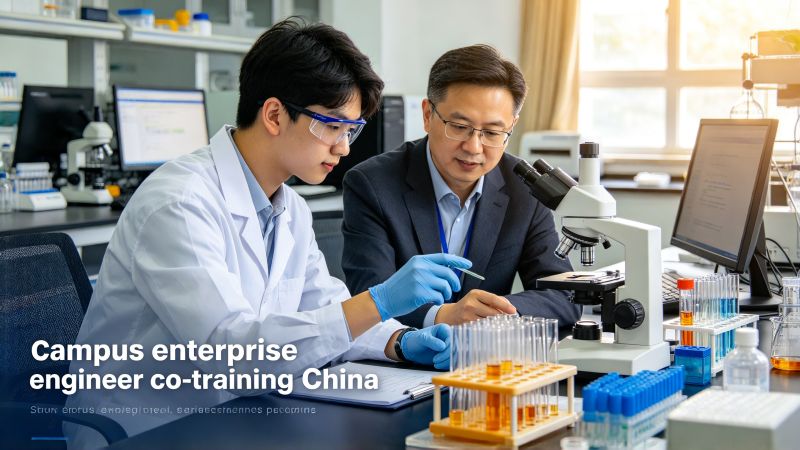
The same day, the Ministry of Education and related departments held a work conference on industry-education integration in Excellent Engineer training and released a second set of numbers. China has built 50 National Excellent Engineer Colleges and is jointly training nearly 36,000 engineering master's and doctoral candidates with enterprises; those students have produced more than 26,000 innovation outcomes since the reform began, most of them converted into applications on site. The training model differs from a conventional research degree at almost every step: universities and companies admit students jointly, set topics jointly and share results. Enterprises have supplied more than 25,000 real research topics, nominated over 13,000 enterprise mentors and chief engineers, and co-built 300-plus engineer technology centers. Master's candidates spend at least one year inside the partner company, doctoral candidates at least two.
Assessment is changing with it. By August 2026, more than 400 engineering master's and doctoral candidates had earned their degrees through practice outcomes — product designs, engineering schemes — rather than papers alone. South China University of Technology graduated the country's first "three-certificate" PhD, carrying a diploma, a degree and a senior engineer title at once; in Zhejiang and Guangdong, more than 1,100 engineering master's graduates received engineer titles directly upon graduation. Zhejiang University's National Excellent Engineer College alone enrolled 1,700 new master's and doctoral students this autumn across 40-plus programs in smart energy, artificial intelligence and integrated circuits. The Ministry of Education has said the model will now extend to all 67 professional master's degree categories, and onward into undergraduate education and overseas.
Read together, the two press conferences describe one system. The spending plan defines which engineering fields will grow; the college system decides who gets trained for those fields and which employers they meet first. Companies that treat the second part as somebody else's business will meet its graduates only as competitors' employees.
The single most consequential figure in the education release is 81%. Among the first cohort of 2,000-plus engineering master's graduates, 81% stayed with key enterprises in their own field. Companies keep them through early contracting, waived probation periods and seniority credits; several provinces now hand engineer titles over at graduation. The percentage says two things at once. Matching is unusually good — students work on the company's real problems for years before graduation, so neither side is guessing. And destination is unusually concentrated — the first customized batch essentially bypassed the open job market entirely.
For mid-size and growing employers, the effect shows up in the autumn recruiting season. Recruiters placing engineering talent in precision manufacturing and semiconductors report thinner resume stacks from top programs in exactly the specialties that matter, because the strongest students were contracted years earlier through the co-training track. The competition for new engineering talent has moved upstream, from the offer letter to the admission and topic-selection stage. With the Ministry of Education pushing the model from 36,000 students toward all 67 professional master's categories, the portion of top graduates circulating through open channels will keep shrinking. Campus-enterprise cooperation has shifted from a nice-to-have to a load-bearing wall in China engineering recruitment.

What remains in the open market is the stock of engineers trained the traditional way, and within that stock the scarcest group is consistent across sectors: engineers with five to ten years of experience who have carried a project end to end. Chip design, compute infrastructure, robot motion control and precision manufacturing processes show the sharpest competition. Industry talent reports show pay growth for senior R&D roles running above the all-industry average, with the spread between top-quartile offers widening as anchor employers bid for the same profiles.
Time is the other rising cost. Henderson Executive Search's senior consultants observe that the hard part of senior engineering recruitment rarely involves screening; it involves reaching engineers who are not looking. The strongest candidates are mid-project, well paid and reachable through peers and search consultants rather than job boards. A retained search for a senior R&D engineer typically runs three to six months, and a realistic schedule from kickoff to start date — allowing for notice periods and project handovers — should budget six. Geography tightens the market further: with 58.8% of R&D funding concentrated in the three hubs, second-tier cities such as Xi'an, Wuhan, Chengdu and Hefei hold real depth in specific disciplines but shallower overall pools. Site selection and talent strategy now need to be decided together, before the org chart is drawn.
The pressure arrives where the spending goes. Mapping the "15th Five-Year" task list against the search assignments Henderson Executive Search has received over the past two years, five industries sit at the front of the queue.
| Industry | Hardest engineering roles to fill | Why now |
| Chips & semiconductor equipment | Analog IC design; packaging & test process; equipment application engineers | Long training cycles; top graduates pre-contracted by anchor firms |
| AI & compute infrastructure | Algorithm engineers; power, liquid-cooling and cluster-scheduling engineers | Fast-moving stack; cross-disciplinary requirements |
| Robotics & smart manufacturing | Motion control; reducers & servo systems; production-line integration | Mass-production ramp releasing roles in concentrated regions |
| New energy vehicles | Battery systems; vehicle integration; overseas certification engineers | OEMs and suppliers bidding for the same profiles |
| Industrial mother machines & high-end equipment | CNC systems; precision process; reliability engineers | Thin senior bench; searches must cross industries |
The five share the same anatomy: young technology stacks, cross-disciplinary demands, long training cycles — the exact fields the Excellent Engineer reform targets. The nearer an employer stands to the national research agenda, the more urgent it becomes to run two tracks at once: entering the co-training pipeline to reach engineers before graduation, and using retained executive search to reach senior engineers already in industry.
Three moves separate the employers adapting well from those still recruiting as if the funnel were unchanged. First, enter the pipeline. Companies that can qualify are joining National Excellent Engineer College schemes — supplying real topics, hosting in-enterprise practice, seconding mentors — which moves recruitment to the admission and topic-selection stage. Firms without that access yet can start smaller: internship bases, joint laboratories, scholarship programs that put the company's engineering story in front of students early. Second, move campus hiring forward. Since top engineering master's candidates are contracted before graduation, offers need to go out earlier, with long internships and conversion paths replacing the old rhythm of competing at the autumn fair's tail end. Third, hand senior searches to specialists in parallel. Senior engineers respond to direct, discreet outreach informed by real technical understanding — work that suits a retained search firm — while employer-brand content keeps building the campus track underneath.
Henderson Executive Search runs engineering and industrial recruitment from Guangzhou, inside the Greater Bay Area hub that holds a third of the national R&D budget alongside Beijing and Shanghai. The vantage point makes the scheduling question concrete: 3.92 trillion yuan, 2.8% of GDP, 50 colleges, 36,000 co-trained engineers, 81% retention — behind every number stands a hiring plan that either anticipated the pipeline or will pay more to work around it. R&D budgets become products and production lines only through people, and the people are being allocated earlier every year.
Q: How is campus-enterprise co-training different from ordinary graduate hiring in China?
A: It moves recruitment to the entrance of the pipeline. Partner companies admit students jointly with the university, supply the research topics — over 25,000 so far — and host at least a year of in-enterprise practice for master's candidates. By graduation the student has solved the employer's actual problems, which is why 81% of the first cohort stayed with key enterprises and why companies offer early contracts, waived probation and immediate engineer titles.
Q: Our company cannot match large firms for top engineering graduates. What should we do?
A: Compete on different ground. Target strong regional universities in your discipline, build internship-to-conversion pipelines, and start conversations in the second or third undergraduate year rather than at graduation. For senior roles, use retained executive search to reach experienced engineers in the open market while the campus track matures. Running both tracks beats bidding against anchor employers for the same few résumés.
Q: When should we start an executive search for senior engineers in China?
A: A retained search for a senior R&D engineer typically runs three to six months; add notice periods and project handovers and a six-month runway to start date is realistic. The working rule: if a vacancy left open for six months would push a product or production milestone, the search should start now, before the requirement is fully finalized.
Q: How should a company choose a headhunter for engineering recruitment in China?
A: Three tests. Has the firm completed searches in the same technical discipline — chip design, motion control, precision process? Can it map which companies and cities the target candidates sit in, rather than forwarding a résumé stack? Will the headhunter stay engaged for three months after the start date? Henderson Executive Search runs engineering and industrial searches from Guangzhou, inside the Greater Bay Area's semiconductor, robotics and new energy vehicle clusters, where the candidates usually are.
Q: Where should a company site an R&D center in China to hire engineers?
A: Beijing-Tianjin-Hebei, the Yangtze River Delta and the Greater Bay Area hold 58.8% of national R&D funding and the densest engineering talent pools. Xi'an, Wuhan, Chengdu and Hefei offer strong depth in specific disciplines at lower cost. Weigh target-discipline density, partner-university access and total cost together — talent availability is now a site-selection variable, not an afterthought.




 China's Exports Went Up-Market. The Trade Talent Didn't | Henderson Headhunter