
 0086-20-3156-0779
0086-20-3156-0779
0086-20-3156-0779


| Metric | 2026 figure | Source |
| Global InP component capacity | Sold out through early 2029; ~70% of demand unmet in 2027, ~30% in 2028 | Lumentum CEO, 9 Oct 2026 |
| China optical module exports, Jan–Aug | $5.06bn, up 47.2%; June alone $711m, up 73.86% | General Administration of Customs |
| Average export price, June | $1,723.83/kg, up 32.66%; volume up 31.06% | Customs |
| Exports by province, August | Jiangsu $308m (+80.7%); Sichuan $233m (+371.0%); Hubei $54m (+58.1%) | Customs |
| Thailand telecom exports, Jan–Jul | THB 563.62bn, up 143.1% | Thai Customs (HS 8517.62.00) |
| Global datacom module market, 2026E | $22.8bn to $28.5bn; ~20% CAGR 2025–30 | LightCounting |
| Global 1.6T module market, 2026E | 22 million units; $4.5bn | Citi; MIIT white paper |
| Global EML demand vs capacity, 2026 | ~350m chips needed vs just over 200m available | Yunling Photonics IPO filing response |
| Domestic content, high-end optical chips | ~4% at 25G and above; under 10% above 100G | Industry estimates |
Set the two datasets side by side and the shape of this cycle appears. Lumentum's supply table is a gap curve running to 2029; Chinese customs show optical module exports of $5.06 billion in the first eight months, with June alone at $711 million, up 73.86%, and an average export price up 32.66% while volume rose 31.06%. Prices and orders are rising; supply is responding far more slowly.
Headcount shows how slowly. Zhongji Innolight raised R&D staff from 1,453 to 2,169 in 2025, up 49.28%; HGTECH ended the year with 2,698, up 8.66%. The leading firms have expanded as fast as they can. Henderson Executive Search's optical communications consultants describe the recurring pattern: clients ask whether three to five viable candidates exist for a role, and the answer is often that only a handful qualify. The export mix is also shifting toward higher speeds — 800G is now mainstream and 1.6T optical modules are entering volume commercialisation — and the faster the product, the more it depends on process control and yield.
The provincial breakdown carries a story about geography. In August, Jiangsu exported $308 million of optical modules, up 80.7%; Sichuan $233 million, up 371.0%; Hubei $54 million, up 58.1%. Jiangsu leads on Zhongji Innolight, TFC Optical and Coherent's Wuxi lines; Sichuan on Eoptolink and Source Photonics. That map looks nothing like the fibre-and-cable ledger of a decade ago.
The more consequential shift runs outward. To manage geopolitical risk and optimise supply chains, manufacturing has concentrated in Penang in Malaysia, Chonburi and Ayutthaya in Thailand, and around Hanoi in Vietnam — clusters producing 400G/800G/1.6T optical modules and components. Thai Customs offers a window: telecom equipment exports under HS 8517.62.00, which includes optical modules, reached THB 563.62 billion for January to July, up 143.1%.
The Chinese leaders' Thailand timelines read as a single narrative. Zhongji Innolight says its Thai plant's capability now matches its domestic lines and that from the second quarter of 2025 Thai output could fully cover North American orders. Eoptolink, TFC Optical and HGTECH all brought Thai lines online between 2024 and 2025. Henderson Executive Search's overseas recruitment specialists see a new layer in what offshoring does to hiring: because yield depends on process experience, a Thai plant cannot be staffed locally alone — core process, test and equipment engineers must be relocated as a cohort while hiring continues at home. That "one role, two locations" mandate is hard to fill: candidates need volume experience on high-speed optical modules and a willingness to work overseas.
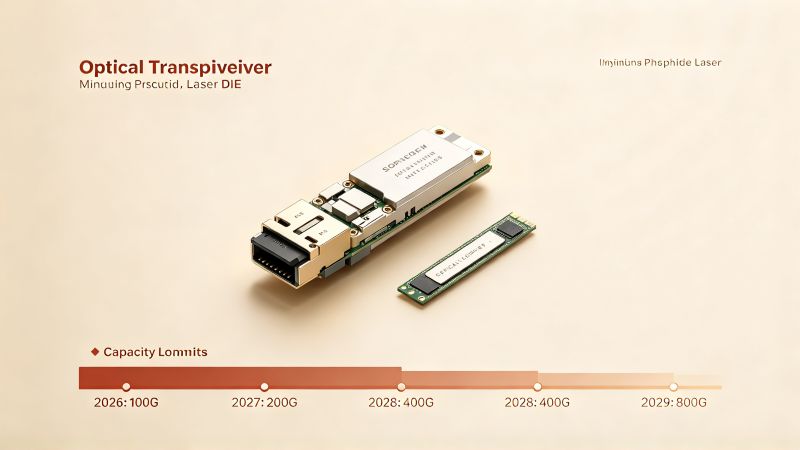
The supply chain is long and tight at both ends. Upstream, EML — the electro-absorption modulated laser — is the core active chip, made through indium phosphide epitaxial growth, lithography and etching. Yunling Photonics' response to an IPO filing query is precise: global EML demand in 2026 is about 350 million chips against capacity of just over 200 million. Lumentum puts the EML gap at 25–30%, with orders locked well into 2027.
Why the gap cannot close quickly comes down to equipment and yield. Lead times for advanced InP growth furnaces, epitaxy tools and packaging equipment typically run 18 to 24 months; for MOCVD reactors and electron-beam lithography, two to three years. Chip expansion is linear while demand is exponential. Prices say it plainly: 100G EML moved from $5 to $7–8, spot premiums on 200G EML exceed 50%, and high-power CW light sources nearly doubled within a year.
Domestic substitution is progressing at very different speeds. Industry estimates put Chinese content at about 4% for optical chips at 25G and above, and under 10% for EML above 100G; Lumentum, Coherent and Broadcom hold more than 70% of the global EML market. Dongshan Precision's Source Photonics unit is the only domestic supplier mass-producing 200G EML. The financials are following — Yuanjie Semiconductor's first-half revenue rose 351% to RMB 925 million — but the remaining gap is yield: 30–40% at home against 60%+ overseas. Henderson Executive Search's semiconductor and optical component consultants see the genuinely scarce profile as the process engineer who can lift yield from 30% to 60%.
At the role level, the shortage is structural rather than a matter of headcount. Industry talent reports put the demand-to-supply ratio for senior R&D engineers and optical design specialists near 1:10. Of roughly 300,000 people working in China's optical component sector, fewer than 15% of R&D staff hold a master's degree or above, and only a few hundred are genuine technology leaders. One leading firm reports first-year attrition of 35%, above the industry average.
Demand growth is specific. Hardware-industry hiring demand is up more than 20% in 2026, and within optical modules, demand for high-speed digital hardware and FPGA engineers is rising about 50% a year, with many roles vacant over six months. Henderson Executive Search's recruitment specialists note the constraint is not overall supply but the right people: plenty of optical communications professionals, yet few who know datacom high-speed modules, on-site troubleshooting in compute clusters, silicon photonics packaging or batch failure analysis.
Critically, these people are rarely on the open market. Core R&D and field application talent sits inside a few leading firms, seldom actively looking, so public channels rarely yield suitable candidates and mapping becomes the primary method. Henderson Executive Search's senior consultants describe the common thread: the job description is precise, but the candidate pool numbers a few dozen, almost all employed.
Understanding the shortage means understanding the pace of iteration. Module speeds step up roughly every two to three years: 400G to 800G, then 1.6T, with 3.2T already sampled. Beyond 800G, copper interconnect can no longer bear the cost and loss, and at 1.6T the industry is validating silicon photonics, LPO, CPO and NPO across several competing paths.
The growth logic has changed with it. LightCounting puts the global datacom module market at $22.8–28.5 billion in 2026, growing about 20% a year to 2030; Citi expects 22 million 1.6T modules to ship this year. Demand is driven by new and expanded hyperscale data centres, weakening the cyclical element — for employers, headcount planning shifts from project-driven swings toward steady expansion on a production cadence.
Where demand lands and where jobs land differ: what scales is the module, what constrains it is the component. LightCounting expects more than half of optical modules to use silicon photonics in 2026, and the coupling process in an optical engine determines both yield and cost — which is why the silicon photonics coupling engineer is a distinct scarce role. The field reliability application engineer, who resolves module failures and intermittent link loss in compute clusters on site, is rarely advertised because most FAEs stay in the lab. Henderson Executive Search's consultants note the difficulty is not salary negotiation but having a pool before there is a conversation.
One number captures the pay shift: advertised salaries for optical module hardware engineers rose about 147% year on year in 2026, far above the 3–5% increase typical across industries. Salary research reports show 1.6T hardware specialists at RMB 750,000 to 1.25 million a year, silicon photonics coupling engineers RMB 580,000 to 980,000, module process and reliability specialists RMB 500,000 to 850,000, and field reliability application engineers RMB 480,000 to 820,000. Silicon photonics chip design pays RMB 300,000 to 500,000 — against fewer than a thousand engineers nationwide.
Geography matters almost as much as role. Shenzhen pays the most in this sector, averaging about RMB 276,000 a year; Suzhou averages around RMB 234,000, while fresh graduates in Wuhan's Optical Valley command about RMB 7,919 a month. As Securities Times reported in August, Wuhan's East Lake High-Tech Development Zone launched a doctorate programme to attract about 100 top PhD graduates a year, 300 over three years. At the launch, more than 30 employers posted over 200 roles with salaries up to RMB 800,000, some bundled with equity and housing — local governments using PhD quotas to lock in talent, a realistic response for a sector with an eight-year training cycle.
Time to hire tracks seniority: Henderson Executive Search's optical communications consultants see process, test and equipment roles taking two to four months, and senior roles such as silicon photonics design and high-speed hardware specialists four to six months, with candidates almost always employed and reachable only by direct approach. If a vacancy threatens a 1.6T ramp or a customer validation milestone, the search should start now.
Q: Which optical module roles are hardest to fill in China right now?
A: Three clusters. Upstream optical chips — EML epitaxy, device design and yield engineering — where the national pool is tiny. Silicon photonics coupling and module process and reliability engineers, who own engine coupling and batch failure analysis. And high-speed digital hardware, FPGA and interconnect simulation engineers, where demand is rising about 50% a year. A colder fourth category is the field reliability application engineer resolving module failures inside compute clusters.
Q: Why is optical module engineer recruitment so difficult?
A: The difficulty is structural rather than volume. Industry talent reports put the demand-to-supply ratio for core roles near 1:10; there are about 300,000 people in the sector, but fewer than 15% of R&D staff hold a master's degree or above. The work requires optics plus electronics, universities have almost no matching programme, and the training cycle exceeds eight years. Core talent also sits inside a handful of firms and seldom looks.
Q: What does the sold-out component capacity mean for hiring?
A: It means expansion is pulled by orders rather than forecasts. Lumentum's capacity is sold out through early 2029 and it will invest at least a further $350 million; in China, Zhongji Innolight raised R&D headcount 49.28% in 2025 and its first-quarter 2026 prepayments jumped to RMB 1.487 billion as leading makers locked up upstream materials. Henderson Executive Search sees component-related mandates issued at project-approval stage.
Q: How does the shift of capacity to Southeast Asia affect recruitment?
A: It creates a "one role, two locations" demand. Zhongji Innolight, Eoptolink, TFC Optical and HGTECH all run Thai plants and are expanding them, and Thai Customs data show telecom equipment exports including optical modules up 143.1% in January to July. Because yield depends on process experience, a new overseas plant cannot be staffed locally alone — core process, test and equipment engineers must be relocated as a cohort while hiring continues domestically.
Q: How should a company choose an optical communications headhunter in China?
A: Three tests. Has the firm completed searches in the same discipline — optical chips, silicon photonics coupling, high-speed digital hardware — and can it tell "shipped 800G" from "shipped 1.6T"? Can it map where the target firms and individuals sit, given that talent concentrates in Shenzhen, Suzhou, Wuhan and Chengdu? And will it stay engaged for three months after the start date? Henderson Executive Search runs optical communications and hard-tech searches from Guangzhou.






 China's Drug Out-Licensing Passed $120 Billion. The BD Talent Didn't Scale With It. | Henderson Headhunter