
 0086-20-3156-0779
0086-20-3156-0779
0086-20-3156-0779


| Metric | 2026 figure | Source |
| Q4 equipment tender round | Expected above RMB 12bn; domestic share likely above 60%, up ~5 points QoQ | SMIC, Hua Hong, ChangXin Memory 12-inch fabs, 8 October 2026 |
| Global equipment billings, Q3 | $43.2bn, up 12% QoQ and 26% YoY, a third consecutive record | SEMI preliminary, 8 October 2026 |
| Mainland China purchases, Q3 | $13.8bn, 32% of the global total | SEMI |
| Full-year equipment sales forecast | Expected above $170bn, ahead of prior consensus | SEMI |
| Domestic content in wafer fab equipment | ~16% in 2024 to ~21% in 2025, 26% forecast for 2026 and 43% by 2028 | Bernstein; Dongwu Securities |
| Domestic content by process step | CMP ~39%, etch ~31%, cleaning ~29%, deposition ~27%; metrology below 10% | Industry research estimates, 2025-26 |
| Lead times, overseas versus domestic | Overseas mainstream tools 12 to 24 months; domestic typically 3 to 8 months, AMEC etch about 9 and Piotech CVD about 10 | ET News, 19 September 2026; Sinolink Securities, 31 August 2026 |
| Listed equipment sector, H1 2026 | 27 companies: revenue RMB 56.69bn, up 31.06%; net profit RMB 13.66bn, up 94.36% | Aggregated interim reports |
| Memory maker expansion | ChangXin raising about RMB 29.5bn, adding 50,000 to 60,000 wafers a month, RMB 35bn to 43bn of equipment spend; YMTC phase three domestic sourcing above 50% | STAR Market registration approval; company disclosures |
Set three figures side by side and the shape of this cycle appears. On demand, SEMI puts mainland China's third-quarter tool purchases at $13.8 billion, 32% of the world total. On supply, Bernstein's estimates trace domestic content in wafer fab equipment from about 16% in 2024 to 21% in 2025, 26% forecast this year and 43% by 2028. What actually shifted procurement decisions is the third figure: lead time.
ET News reported on 19 September that mainstream tools from Applied Materials, ASML, Lam Research, Tokyo Electron and KLA now run at 1.5 to 2 times their former lead times: etch and deposition stretched from roughly six months to twelve, advanced packaging and test tools beyond eighteen, and imported RF power supplies up to twenty-four months. The domestic comparison in the same report: AMEC's etch tools quote about nine months, Piotech's CVD about ten. Sinolink Securities repeated the same order of magnitude on 31 August and noted that Samsung, SK hynix and Micron face the same equipment bottleneck on their expansion plans.
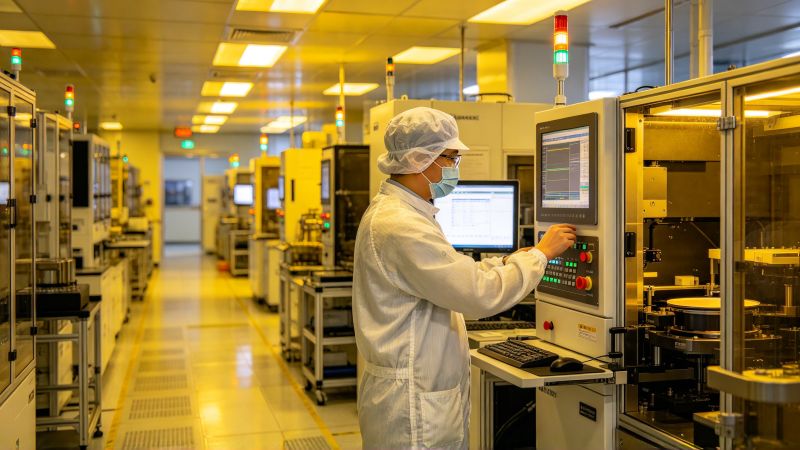
What a lead-time gap means is straightforward on a production line. A 12-inch fab moves from tool arrival to volume output through installation, calibration, process qualification, small-batch ramp and yield stabilisation. A quarter lost at any of those steps costs a market window rather than depreciation. When an overseas tool takes two years and a domestic one nine months, the question changes from whether to buy domestic to whether the ramp can happen at all without it. That is the practical driver behind the 60% domestic share in the 8 October round: fabs raised domestic content for supply-chain resilience and because their own ramp schedules demanded it. Henderson Executive Search sees this pattern repeatedly in the mandates it handles for both vendors and fabs.
The 2026 story is no longer that a given tool has been developed; it is how many percentage points of share moved. Bernstein forecasts 26% this year, 34% in 2027 and 43% in 2028. Other industry estimates put domestic content in mature-node processes at Chinese fabs at about 35% in 2024 rising to roughly 55% in 2025. The spread between these numbers comes from scope, whether counted by units or by value and whether components and peripheral tools are included, but the direction and the slope agree.
By process step the divergence matters more than the total. CMP sits near 39% domestic content, etch about 31%, cleaning about 29% and deposition about 27%, while metrology remains below 10% and coating and lithography stay low. Etch is the most concentrated: CITIC Securities put AMEC and NAURA at roughly 95% of domestic etch supply as of 20 August. In etch, the question has moved from whether a domestic option exists to where share can expand, a shift Henderson Executive Search's semiconductor practice has tracked through candidate pools that barely change in size.
The industry's financials confirm it. Aggregated interim reports show 27 listed Chinese equipment companies with first-half revenue of RMB 56.69 billion, up 31.06%, net profit of RMB 13.66 billion, up 94.36%, and contract liabilities of RMB 22.62 billion, up 12.80%. Contract liabilities are a leading indicator of orders, and their growth shows downstream demand still releasing. NAURA, the only Chinese company in the global top ten with $4.23 billion of 2025 revenue, passed RMB 20 billion in first-half revenue with integrated circuit equipment growing more than 50%.
Memory makers provide the demand-side corroboration. ChangXin Memory obtained STAR Market registration approval in June 2026, plans to raise about RMB 29.5 billion, began a new tender round in the second quarter to add 50,000 to 60,000 wafers a month against RMB 35 billion to 43 billion of equipment spending, and targets domestic content above 40% on the new platform. YMTC's phase three lines are in install with production due by the end of 2026 and domestic sourcing above 50%. The two companies lifted their combined 2026 expansion plans from 100,000-120,000 to about 150,000 wafers a month. Equipment revenue recognition lags orders by roughly a year, so this capital expenditure wave lands mainly in 2027 and 2028. The hiring preparation period is longer than the tool lead time.
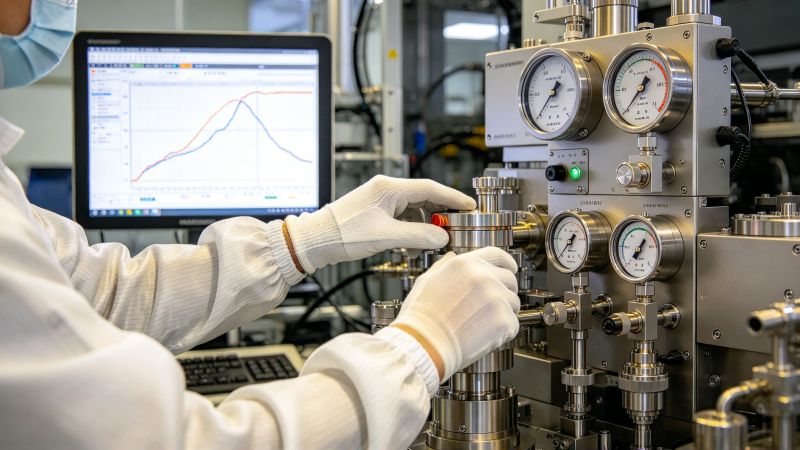
Selling the tool is the beginning. An etch system moves from delivery to yield through installation, levelling, vacuum and gas-flow tuning, recipe matching, on-wafer qualification and stability testing, and every step is done by people. TSMC senior vice president Kevin Hou spoke publicly at a September 2026 industry forum about the Arizona situation: after the building shell is complete, bringing volume tools in and dialling them up needs experienced technicians, while 2026 demand pushed equipment procurement to 1.9 times the baseline within six months, leaving installation staffing unable to match. N3 production at the Arizona phase two site slipped to the second half of 2027 as a result. The cleanroom was ready, the tools could not be brought in, and once they were, yield would not follow — the binding constraint sat entirely with people.
In China the roles divide into three layers. First, installation and commissioning engineers, who take a new tool through set-up, parameter calibration and first process matching, requiring familiarity with mechanical, vacuum, RF and thermal subsystems. Second, equipment maintenance and fault diagnosis engineers, who own scheduled service, anomaly investigation and parameter drift analysis without interrupting production. Third, equipment development and subsystem engineers on the vendor side, who translate process requirements into machine specifications and iterate. All three layers are expanding simultaneously as both equipment vendors and fabs scale up.
A fourth capability is gaining weight: service radius. Chinese equipment vendors have been selling delivery, service and local spares as a package. Industry reporting describes response times measured in a few hours from teams stationed in core cities, domestic spare parts warehouses with three to seven day delivery and common-part coverage above 90%, against one to twelve weeks for overseas spares and supply risk on specialised parts. That service model requires a technical support force dense and close enough to reach any customer line. Henderson Executive Search's semiconductor consultants see resident field service engineers among the fastest-growing roles at domestic vendors, with one position needed in each of Shanghai, Wuxi, Hefei, Wuhan and Chengdu, and a requirement to resolve issues independently on the customer's line rather than escalate.
One caveat before the numbers: pay in this sector correlates with qualifications but correlates far more strongly with production experience. Industry talent reports show equipment and process hiring demand up more than 35% year on year in the 2026 spring season, with master's graduates starting at RMB 13,000 to 20,000 a month, a 23.5% rise against 15.2% for master's graduates across all industries. The spread that matters is inside the band: the same job title at three years and at eight years can differ by two to three times, because the first is priced on education and the second on whether the candidate has taken a line from install to volume yield.
| Role | Experience and pay, 2026 | Hiring signal |
| Etch equipment engineer | 5 to 10 years, RMB 20,000 to 50,000 a month over 15 to 16 months | Domestic etch supply concentrated at about 95% between two vendors |
| Deposition equipment engineer | 5 to 10 years, RMB 20,000 to 35,000 a month over 16 months | Domestic content about 27%, orders releasing through the ramp |
| Cleaning and CMP equipment engineer | 5 to 10 years, RMB 20,000 to 30,000 a month over 16 months | Higher domestic content, direct delivery pressure |
| Process integration engineer (PIE) | RMB 260,000 to 1.1m a year, median around RMB 456,000 | Spans multiple steps; cross-tool problem solving required |
| Installation and commissioning engineer | 3 to 5 years, RMB 15,000 to 25,000 a month plus travel and site allowance | Demand spikes when new fabs take delivery of new tools |
| Resident field service engineer | 5 to 10 years, RMB 15,000 to 20,000 a month over 15 months | One per city; must resolve issues independently on site |
| Equipment R&D and subsystem engineer | Master's preferred, RMB 200,000 to 500,000 a year, higher for senior | Must read process requirements and engineering limits together |
| Domestic qualification engineer | 5 years and above, adjusted upward by employer | A role created by the substitution cycle, owning the full qualification path |
Henderson Executive Search compiles these bands from public job postings and industry research; they are sensitive to city, ownership and project urgency. They are order-of-magnitude references rather than a distribution. One structural detail matters for offers: project bonus and site allowance form a material share of pay, so the same title on headquarters headcount and on-site at a customer fab can differ well beyond the advertised monthly figure.
The education ladder is shallow here. Master's graduates start at RMB 13,000 to 20,000 a month, bachelor's sit one step lower, and doctoral candidates entering R&D see a modest premium, with the bachelor's to master's multiple just above one and master's to doctorate under two. Against chip design, where qualifications can shift pay two or three times, the price signal in equipment and process work is flat.
Pricing power is therefore established within the band rather than between bands. Two etch equipment engineers can differ by more than double depending on whether one has taken a 12-inch line from installation to volume yield and the other has only run single-tool qualification in a lab. Two process integration engineers diverge similarly by whether they have handled a stacking-step transition at a memory maker. This also explains why job tenures in equipment run longer than in chip design: migration between fabs and tool platforms carries high cost, and bargaining power only crystallises once a candidate has completed a line end to end.
Geographically, equipment and process roles track wafer manufacturing almost exactly — Shanghai, Wuxi and Beijing as the established cluster, with Hefei, Chengdu and Wuhan growing quickly as new bases come online. Henderson Executive Search's semiconductor consultants observe that when one employer posts the same role in different cities, the pay gap mainly reflects housing and living costs rather than the value of the job. Henderson Executive Search's consultants see that as where cross-city offers break down most often: the candidate is calculating a household balance sheet while the employer is calculating a salary band.
Five qualifications belong on this analysis. First, domestic content ratios are not comparable across sources because of unit-versus-value and component scope differences; only the directionally consistent figures are used here, each attributed. Second, the RMB 12 billion tender figure is an industry estimate at launch and awaits final award results. Third, if overseas lead times normalise, the lead-time rationale for substitution weakens and domestic tools will compete on specification and service alone. Fourth, the pay bands aggregate public postings and industry research and do not constitute percentile statistics. Fifth, there is no public role-level data on mobility in this sector, so observations about willingness to move come from search practice rather than measurement.
Four public indicators are worth tracking quarterly: SEMI's global and mainland China billings, fab capital expenditure and tender announcements from the leading foundries and memory makers, contract liabilities and inventory lines in equipment vendors' interim reports, and disclosed wafer additions and domestic content ratios at the memory makers. Together they give a directional read two to four quarters ahead on hiring demand.
For domestic equipment vendors, the binding constraint sits in delivery and service organisation rather than the order book. Tools must arrive on schedule and reach a process window, which requires an installation and support force deployable across several cities at once. These mandates are high-volume, geographically dispersed and urgent, and filling them one search at a time is inefficient. A better approach is to map target employers, target lines and target cities first, build the reachable population, and approach candidates in phases aligned to project milestones. Henderson Executive Search's consultants report that such mandates began roughly a quarter earlier in 2026 than in previous years, as clients moved critical hires ahead of capacity release instead of behind it.
For fabs, rising domestic content raises a question that gets less attention: the skill profile of process and equipment teams has to move with it. Engineers configured around overseas tool platforms do not transfer unchanged, because subsystem design, tuning paths and failure modes differ by vendor. Moving a line from a mainly imported tool set to more than half domestic requires people who understand the process window and are willing to relearn a platform. The resistance in that transition is rarely pay; it is the resetting of accumulated experience, which requires a clear position on training investment and internal career paths.
For overseas employers hiring in China, one practical note: the candidate population for equipment and process roles is concentrated in a handful of fabs and vendors and is almost entirely employed. Recruitment through public channels tends to surface equipment operation or maintenance experience rather than the process-level problem solving these roles require. Mapping the target population early, and budgeting for the fact that the strongest candidates are not looking, is the difference between a filled role and a delayed ramp.
Q: Which semiconductor equipment roles carry the tightest supply in China right now?
A: Three clusters stand out. Installation and commissioning engineers, where demand concentrates around new fab openings and delivery waves, requiring familiarity with vacuum, RF and thermal subsystems and the ability to complete calibration and first process matching independently. Equipment maintenance and fault diagnosis engineers, who analyse parameter drift and resolve anomalies without stopping production. And vendor-side equipment and subsystem engineers who translate process requirements into machine specifications. A fourth, newer category is the domestic qualification engineer, who owns the full path of bringing a domestic tool into a production line.
Q: Why is equipment engineer recruitment so difficult?
A: Because experience does not transfer cleanly. The value of a process or equipment engineer is bound to a specific line and tool platform, so someone who took a 12-inch line from install to volume yield cannot be equated with someone who ran single-tool qualification in a lab. Industry talent reports show equipment and process demand up more than 35% year on year in the 2026 spring season, but candidates with the required line experience sit inside a handful of fabs and vendors and are mostly employed. Public channels surface a great deal of equipment operation and maintenance experience and very little process-level problem solving.
Q: What does rising domestic content mean for hiring?
A: Demand increases on two fronts at once. Vendors need larger installation teams, resident field service teams and R&D groups; fabs need to migrate their process and equipment skill base toward domestic platforms. Domestic tools typically deliver in three to eight months against twelve to twenty-four for overseas mainstream models, which compresses installation and qualification on the timeline and raises the peak staffing requirement. Henderson Executive Search observes that clients moved critical hires earlier, ahead of capacity release rather than after it.
Q: What pay levels should employers expect?
A: Salary research reports show master's graduates starting at RMB 13,000 to 20,000 a month, up 23.5% year on year and above the 15.2% average for master's graduates across industries. Experienced candidates diverge sharply: etch equipment engineers at five to ten years command RMB 20,000 to 50,000 a month over fifteen to sixteen months; deposition and cleaning engineers RMB 20,000 to 35,000 over sixteen months; installation and commissioning engineers at three to five years RMB 15,000 to 25,000 plus travel and site allowance; process integration engineers RMB 260,000 to 1.1 million a year with a median around RMB 456,000. These are aggregated ranges, not percentile statistics.
Q: How should a company choose a semiconductor headhunter in China?
A: Three tests. Can the firm distinguish "did equipment maintenance" from "completed installation and commissioning", and "worked mature-node processes" from "ran high-aspect-ratio stacking steps at a memory maker"? Can it describe the talent map across the fabs and cities where these engineers cluster — Shanghai, Wuxi, Beijing, Hefei, Wuhan, Chengdu? And can it run high-volume, multi-city mandates rather than single-point search? Henderson Executive Search runs semiconductor, optical communications and hard-tech searches from Guangzhou, covering the Yangtze Delta and central China wafer fabrication clusters. That proximity is one useful signal when assessing a search partner.





 Optical Component Capacity Is Sold Out to 2029. The Talent Gap Is Wider