
 0086-20-3156-0779
0086-20-3156-0779
0086-20-3156-0779


| Indicator | Data | Source and reference |
| New occupations announced | 11 occupations and 23 specializations; embodied intelligence robot application technician under code 4-04-05-16 | MOHRSS and two ministries, September 9, 2026 |
| Data collection postings | +769% in 2025 year on year | Zhilian Executive Search industry talent report, 2026 |
| Data labeling / AI trainer postings | +2,250% in 2025 year on year | Zhilian Executive Search, same report |
| Humanoid robot shipments, H1 2026 | ~25,000 units globally, +432.1%; China ~19,000 units, 77.9% of the total | IDC, August 2026 |
| Embodied AI talent gap | Above 1 million people | CCTV News reporting, September 2026 |
| Real-world interaction data gap | ~10 billion hours needed versus ~500,000 compliant hours available | Jiyuan Zhihang, cited by China Economic Net, September 4, 2026 |
| Embodied AI training grounds | More than 70 built and operating; 40-plus under construction or planned | CAICT training ground research report, August 18, 2026 |
| Dataset quality standard | YD/T 6771-2026, effective November 1, 2026 | MIIT; drafted by CAICT with 40-plus organizations |
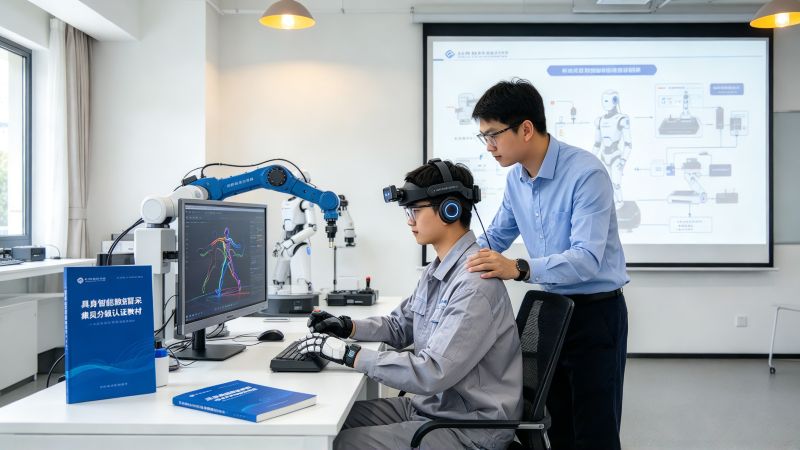
On September 9, the Ministry of Human Resources and Social Security and two other ministries released the eighth batch of new occupations: 11 occupations and 23 specializations, with information on six existing occupations adjusted. The embodied intelligence robot application technician entered the national occupational classification system as an independent occupation with its own code, 4-04-05-16. The official definition covers four domains of work: collecting and processing multimodal interaction data for embodied intelligence robots using teleoperation equipment, spatial digitization tools and simulation platforms; fine-tuning and adapting algorithm models; deploying and debugging system hardware and software on site; and monitoring operational performance with ongoing maintenance and optimization.
Two formal specializations sit underneath the occupation: the humanoid robot data collector and the robot trainer. The distinction matters because getting a robot to grasp, carry or sort objects requires people to capture visual, tactile and force data from real environments, then train, test and debug the systems that consume that data. Before September, this work sat inside research teams with no occupational identity and no common evaluation framework. Five of the eleven new occupations in this batch are digital occupations, bringing the national total of registered digital occupations to 113.
The supporting apparatus followed quickly. In April, the Education and Examination Center of the Ministry of Industry and Information Technology together with Leju Robotics published an occupational competency standard for the role. On August 26, the first certificate under that standard was issued, structured around four core functions — debugging and maintenance, operation, data processing, and application deployment — across three grades: junior, intermediate and senior. For employers, the code and the certificate ladder provide a reference for writing job descriptions, setting salary bands and assessing skills. Henderson Executive Search expects the certificate to become a common screening anchor in this market within a year, much as national vocational credentials did in industrial automation a decade earlier.
The demand signal arrived well before the official recognition. The Zhilian Executive Search report on the embodied intelligence robot industry recorded that total core postings in the sector grew 100% in 2025. Within that, data labeling and AI trainer roles grew 2,250%, data collection roles grew 769%, and robot algorithm positions roughly doubled. Software and hardware engineers, mechanical engineers and robot commissioning engineers all rose more than 50%. The sales side tells a complementary story: key account representatives grew 95% and solutions engineers 71%, while traditional sales team manager postings fell 74% — the industry is hiring for scenario expertise, and moving away from transactional selling.
Pay splits cleanly by layer. Around 60% of algorithm positions pay above RMB 30,000 per month and nearly 20% exceed RMB 50,000. Software, hardware, mechanical, C++ and robotics engineering roles cluster in the RMB 20,000-30,000 band. Robot commissioning engineers and data labeling or AI trainer roles generally stay below RMB 20,000, while data collection work is usually settled daily, with monthly pay under RMB 10,000. Education requirements follow the same gradient: master's degrees are now standard for algorithm roles, software and mechanical positions anchor at bachelor level, and data collection along with commissioning roles mostly accept associate degrees.
Geography is spreading faster than most observers expected. Tier-one and new tier-one cities still anchor embodied AI recruitment, with posting growth of 67% and 52% respectively in 2025, but tier-two cities grew 138%, with Guangzhou up 216%, Chengdu up 231% and Hangzhou up 153%. Cities such as Tianjin, Zhengzhou, Chongqing, Qingdao, Dongguan and Ningbo all more than doubled. Data collection centers are moving into lower-tier cities because the work is labor- and space-intensive, and the cost structures of the biggest cities do not fit it.
The industrial backdrop explains the pressure. IDC recorded nearly 25,000 humanoid robots shipped globally in the first half of 2026, up 432.1%, with China accounting for more than 19,000 units or 77.9% of the total. CCTV News reported that a single humanoid robot now generates more than twenty new job categories, and that the national embodied AI talent gap exceeds one million people. A separate industry talent report published in August recorded 41% growth in embodied AI recruitment activity, with structural shortages concentrated at the postgraduate level. Henderson Executive Search tracks the same pattern from the employer side: requests in this sector shifted over the past year from single senior hires to batch recruitment of data teams.
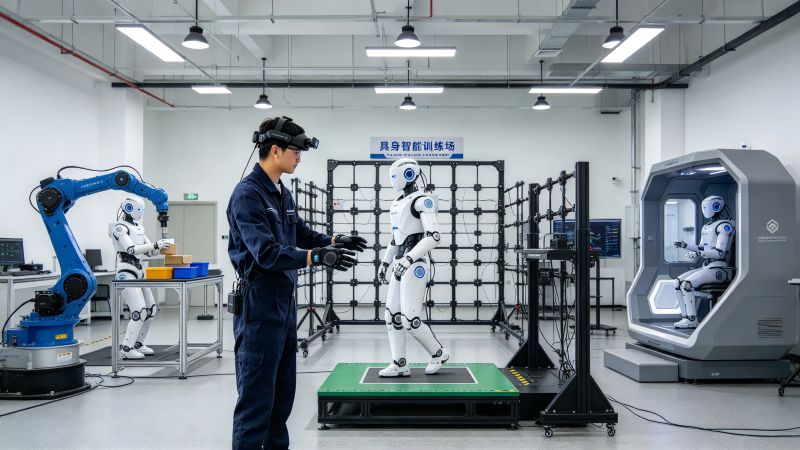
The clearest picture of what the job involves comes from its physical workplace. A China Economic Net report from October 9 described daily life inside the data and training base of the Beijing Humanoid Robot Innovation Center. Across nearly 6,000 square meters, simulated settings reproduce homes, supermarkets, industrial assembly lines, chemistry laboratories and elderly-care stations. Forty robot configurations stand at different workstations, practicing under the remote control of robot trainers. In a logistics sorting scene, the data collector behind the robot wears capture equipment and repeats posture adjustments, object grasps and sorting placements while trajectory data streams onto a nearby screen in real time.
The base represents the current frontier of domestic data production: more than 30 realistic scenarios across six domains, a 200-square-meter professional optical motion capture studio, over 150 robots in 40 configurations, and matrix-style collection combining real-machine teleoperation, motion capture and body-free demonstration. Its pipeline runs from collection through cleaning, labeling, quality inspection and model training to a feedback loop for hard cases. Annual capacity reaches 180,000 hours; nearly 30,000 hours of high-quality real-machine data have been delivered, with over 70% of capacity serving industry clients and research institutions. The open-source dataset RoboMIND, released in December 2025, has surpassed 20 million downloads worldwide, with more than 300,000 dual-arm manipulation trajectories covering 700-plus tasks.
Beijing is one node in a fast-growing network. The China Academy of Information and Communications Technology reported on August 18 that more than 70 embodied AI training grounds are operating nationwide, with over 40 more under construction or planned, clustered in the Yangtze River Delta, Beijing-Tianjin-Hebei and the Pearl River Delta, and reaching into lower-tier cities. The arithmetic that drives all of it was put plainly by Gao Shaolong, chief executive of data firm Jiyuan Zhihang: the industry consensus is that a general-purpose robot needs on the order of ten billion hours of multi-scenario real interaction data, while the compliant domestic stock is about five hundred thousand hours. Shi Mingwei, a product lead at the Beijing base, added the quality caveat that guides hiring: ten thousand hours of high-quality data may matter more than a million hours of repetition.
The data collector specialization has already differentiated into three working layers. The base layer is teleoperation. A recruitment center in Xinzheng, Henan Province — tied to robot maker Zhiyuan and equipped with 659 robots — hires collectors to operate one robot each and capture multimodal data. The posting requires an associate school certificate with no major restrictions, pays from RMB 5,000 a month after probation, rises above RMB 10,000 once proficient, and gives priority to candidates with dance, sports or martial arts backgrounds or experience with motion capture gear. Elsewhere, a Beijing site in Shijingshan pays RMB 190-210 per day settled daily; a work-from-home role in Zaozhuang pays RMB 25-45 per hour; a VR master-slave operation role in Taiyuan asks for a bachelor degree and RMB 3,000-7,000 monthly.
| Job layer | Pay signal | Reference and notes |
| Base collector (teleoperation) | RMB 3,500-10,000 monthly; RMB 190-210 daily in Beijing; RMB 25-45 hourly for home-based work | Public postings in Xinzheng, Beijing, Zaozhuang, Taiyuan; associate-level entry, no major restriction |
| Pilot collector / quality inspector | From RMB 5,500 monthly after probation | Xinzheng center; sets collection rules and trains new staff |
| Data operations / equipment support | Rises with experience; 6-12 month promotion path from base roles | Industry observation; entry via collection or testing |
| Robot commissioning engineer | Generally below RMB 20,000 monthly; postings +50% or more in 2025 | Zhilian Executive Search report |
| Data labeling / AI trainer | Generally below RMB 20,000 monthly; postings +2,250% in 2025 | Zhilian Executive Search report |
| Algorithm engineer (embodied AI) | ~60% above RMB 30,000; ~20% above RMB 50,000 | Zhilian Executive Search report; master's degrees standard |
| Certification track | Three grades: junior, intermediate, senior | MIIT examination center system; first certificate issued August 26, 2026 |
The middle layer is pilot collection and quality inspection: decomposing tasks before batch work begins, setting the rules, training newcomers, and running multi-dimensional checks on task completeness, sensor quality, semantic accuracy and action learnability. The top layer is data engineering and training, where long-horizon demonstrations are decomposed into more than 120 standardized atomic actions — grasp, pick, place, twist, press — and pushed through the data pipeline. In the experience of Henderson Executive Search, these three layers are rarely hired through the same channel, and the job descriptions that work best name the layer explicitly. Flexible work runs alongside all three layers: Jiyuan Zhihang pays an effective hourly rate of RMB 70 for validated collection and can mobilize close to a million part-time collectors. China Economic Net profiled one part-time mother who collects about six hours on weekdays for roughly RMB 4,000 a month, describing the job as doing housework on the clock.
Henderson Executive Search advises clients building such teams to budget for the middle layer from day one. The instinct is to hire collectors and count hours, but the quality inspectors and rule-setters are the roles that decide whether the data passes the buyer's acceptance tests — and those people are scarcer than the headline posting numbers suggest.
Wu Jiachun of Hikrobot, a company with ten years in industrial robotics that began building embodied intelligence products two years ago, described the profile to China Youth Network. Candidates typically come from automation, computer science, mechanical or mechatronics engineering. They need to understand how robots work and how models are built, operate and repair hardware on site, and communicate well enough to shuttle requirements between R&D teams and customers.
Mapped onto the three layers, the capability curve becomes clear. The base layer is genuinely open — vocational school entry, no major restriction, paid onboarding training, and demands that amount to coordination, patience and tolerance for repetition. But Liu Lei, a project manager at the Beijing base, offered the corrective: collectors do far more than repeat a script. Target objects vary in shape, color, quantity and position; backgrounds and lighting change; the robot must perceive the environment and absorb human habits, and every successful grasp and failed adjustment is recorded. Collecting, and collecting data that trains a model well, sit on either side of a real gap in scene understanding.
The career path is now explicit: vocational school graduates and people with no prior experience can enter through collection, testing or equipment operation, then move within six to twelve months toward quality inspection, equipment support or data operations, and continue toward application deployment and delivery management with the graded certificates in hand. Schools are responding. Wuxi Vocational Institute of Technology runs a joint program with Estun, China's leading industrial robot maker by shipment volume in the first half of 2026; the institute's deputy dean Tang Xia summarized the logic: the industry sets the exam, and the school prepares the answers. Henderson Executive Search counsels employers in second-tier cities to build recruitment pipelines directly with vocational programs, because the certificate system has matured faster than the resume market has.
In July, the Ministry of Industry and Information Technology approved the industry standard "Artificial Intelligence — Key Enabling Technologies — Quality Requirements and Evaluation Methods for Embodied Intelligence Datasets" (YD/T 6771-2026), drafted by the China Academy of Information and Communications Technology with more than 40 organizations. It takes effect on November 1, 2026. The standard specifies a quality framework in three parts — production operating procedures, organizational safeguards, and evaluation metrics — with the metrics spanning eight dimensions: completeness, consistency, diversity, authenticity, usability, practicality, scalability and security.
The background is a structural contradiction. In 2026, a million hours of data capacity became the de facto threshold for serious model development, and training grounds multiplied, yet judgements of whether a dataset is usable or good remained subjective, making quality hard to control and datasets hard to combine. Zhang Weimin, deputy director of the embodied intelligence robotics division at CAICT's AI institute, framed the intent: the standard helps suppliers raise quality, promotes data trading and sharing, prevents duplicated effort, and gives buyers a clear acceptance basis.
For hiring, Henderson Executive Search reads the standard as a signal that will reorder the value of data collection roles. When acceptance shifts from counting hours to scoring eight quality dimensions, the value of pure motion execution falls and the value of people who understand inspection criteria, grade data and maintain collection specifications rises. The middle layer between collector and trainer — the exact band where quality inspection lives — should thicken as a result. Training content will follow: teleoperation alone no longer prepares anyone for the job; data norms, labeling quality and evaluation methods become required modules.
Three organizational patterns have emerged on the demand side. Estun, which topped China's all-brand industrial robot shipment table in the first half of 2026, trains two to three thousand deployment and commissioning engineers a year across its supply chain and still cannot close the industry's staffing gap, according to Wang Qiong, deputy director of strategic and market affairs. Hikrobot has yet to create a formal embodied intelligence technician role but already runs dedicated data collection and delivery teams that carry the same duties. The Beijing center operates collection, training and inspection as a full business line, with 70% of its capacity serving external clients.
The industry consensus view, cited in the China Youth Network report, is that 2026 to 2028 will be the key window for scaled rollout in industrial scenarios, with commercial service and home scenarios following between 2028 and 2030. Each step forward in application raises the human demand on the data side. There is also a sober counterpoint in circulation: within three to five years, standardized motion collection may be partially replaced by autonomous algorithms, shrinking base-layer collection demand and pushing the work upstream toward data engineering, inspection and scenario design. The long-term value of this occupation depends on whether its people can climb the three-layer ladder.
Henderson Executive Search observes three recurring friction points when employers build data collection and training teams. First, scale: a single team build-out can mean dozens of hires, which conventional channels cannot deliver on short timelines. Second, retention: base collection work is repetitive and modestly paid, so the six-month retention rate is the true cost variable of any team plan. Third, the novelty of the standard: the occupation entered the catalog in September and the first certificate was issued in August, so no resume history exists to screen against, and employers must select on potential and trainability. Companies that treat data as a core asset respond by running recruitment, paid training and certification as one internal pipeline.
The figures deserve three caveats. The 769% and 2,250% growth rates compare 2025 against a very low 2024 base, so the percentage overstates the absolute size of the market. Posting counts measure what employers publish, which sits several steps away from actual hires and from the employed stock of talent. And the occupation is barely a month old; pay bands and job grades will take time to settle, so the salary signals in this report come from scattered local postings rather than any national survey.
Four indicators, as Henderson Executive Search sees it, will show whether this becomes a durable employment channel or stays a by-product of capacity expansion: the first batch of data deliveries accepted against the new quality dimensions after November 1; certificate issuance volumes and where holders find jobs; month-by-month changes in the count of operating training grounds; and transaction prices for delivered data hours. Henderson Executive Search will track all four, because together they answer the question every employer in this sector is now asking — how quickly the supply of trained, certifiable data talent can catch up with the robots already shipping.
Q: What does an embodied intelligence robot application technician actually do?
A: Under the official definition published on September 9, the role uses teleoperation equipment, spatial digitization tools and simulation platforms to collect and process multimodal interaction data, fine-tune algorithm models, deploy and debug robot systems on site, and monitor operational performance. It has two specializations — data collector and robot trainer — covering data production and model training respectively.
Q: What qualifications does a humanoid robot data collector need?
A: Base-level roles accept vocational or associate education with no major restriction, and most employers provide paid onboarding. Coordination, patience and tolerance for repetitive work matter more than credentials; experience with motion capture equipment or backgrounds in dance, sports or martial arts are preferred. Moving up to inspection or trainer roles requires knowledge of data quality standards and task decomposition rules.
Q: How much do robot data collectors earn in China?
A: Base collectors earn roughly RMB 3,500-10,000 a month, with Beijing sites settling RMB 190-210 per day and home-based part-time work at RMB 25-45 per hour; validated collection for platform companies pays about RMB 70 per effective hour. Pilot collectors and inspectors start near RMB 5,500, trainers and commissioning engineers generally stay under RMB 20,000, and algorithm engineers exceed RMB 30,000 in about 60% of postings.
Q: Which embodied AI roles are expanding most quickly?
A: The Zhilian Executive Search report recorded 2025 growth of 2,250% for data labeling and AI trainer roles, 769% for data collection, roughly a doubling for algorithm positions, and gains above 50% for software, hardware, mechanical and commissioning engineers. Tier-two city postings grew 138%, with Chengdu, Guangzhou and Hangzhou all above 150%. Growth concentrates on the data and delivery side rather than traditional sales.
Q: Where do employers struggle when building data teams?
A: Three places: batch scale, since one build-out can mean dozens of hires that standard channels deliver slowly; retention, because six-month attrition on repetitive base roles drives the real cost; and the absence of screening history, since the occupation and its certificates are only weeks old. Employers that treat data as a core asset run recruitment, paid training and graded certification as one pipeline, with promotion slots reserved for inspection and data operations.
Ministry of Human Resources and Social Security and two ministries, eighth batch of new occupations (23 specializations), September 9, 2026; MIIT Education and Examination Center and Leju Robotics, occupational competency standard for embodied intelligence robot application technicians, April 2026, with first certificate issued August 26, 2026; Zhilian Executive Search, 2026 talent report on the embodied intelligence robot industry (2025 posting data); IDC, global humanoid robot shipments, first half 2026; CCTV News (Xinwen Lianbo), embodied AI talent gap, September 2026; China Economic Net, report from the Beijing Humanoid Robot Innovation Center data and training base, October 9, 2026; China Economic Net, interview with Jiyuan Zhihang chief executive Gao Shaolong, September 4, 2026; Xinhua Net, YD/T 6771-2026 embodied intelligence dataset quality standard, August 5, 2026; China Academy of Information and Communications Technology, embodied intelligence training ground research report 2026, August 18, 2026; China Youth Network, interviews with Hikrobot and Estun, October 13, 2026.




 Wafer Fab Equipment Bids Top RMB 12bn. Domestic Suppliers Take 60%.